Saving the Unsalvageable: Where PCRS is Different
Saving the Unsalvageable: Where PCRS is Different
In our industry, we see it all the time. A homeowner walks into their house to find a refrigerator line broken or a supply line to a toilet leaking, and a regular day instantly transforms into an emergency situation.
There are quick decisions to make, and each one feels urgent. As a homeowner, it's an overwhelming situation, and this is where mistakes can occur.
When a homeowner experiences a water loss, the first call they often make is to their insurance company. In many cases, they're handed a list of "preferred vendors" and told to choose from a group of recommended restoration contractors.
While there are certainly restoration contractors on these lists that do a fine job restoring properties, it's important for homeowners to understand that not all contractors approach water damage the same way.
There are companies that operate with what many in our industry call the "cut and gut" mentality. If it's wet, tear it out. If it's damaged, replace it. These companies call demolition their solution and forget what's right in their name: restoration.
Your Home, Your Choice
We are restoration professionals, experts in mitigation, and trained in drying science. For nearly four decades, our family-owned and operated company has helped Connecticut homeowners recover from water damage by focusing on mitigation, not demolition.
While many contractors immediately begin addressing a loss by determining what they can throw out, the question ALL restoration contractors need to be asking is:
"Can this be saved?"
That question matters because the answer can save thousands of dollars for homeowners and insurance companies alike.
Think of a kitchen where water from a plumbing leak has migrated beneath hardwood floors. There are two ways to approach this issue. The immediate and easiest solution is to rip it out and install new flooring. At first glance, this may seem like the safe option, but the actual cost of tearing out the floor extends far beyond the removal itself.
From an insurance perspective, demolishing a hardwood floor may include debris removal, detaching and resetting appliances, removal of baseboards and trim, flooring replacement, sanding, finishing, painting, and touch-up work.
What began as a "quick fix" for a restoration contractor is now a multi-faceted reconstruction project costing thousands of dollars.
The PCRS Difference
When we approach a water loss, our clients' comfort and safety are our number one priority. With that in mind, we determine how mitigation can best be achieved with the least amount of disruption possible.
Unlike "cut and gut" contractors who immediately begin planning demolition, our technicians are trained in accordance with IICRC standards in the science of structural drying. We intimately understand how moisture moves through building materials, how different materials respond to water, and how specialized drying systems can often restore materials that others assume must be removed.
Our goal is not simply to dry a structure. As restoration experts, our focus is to preserve as much of the original structure as possible.
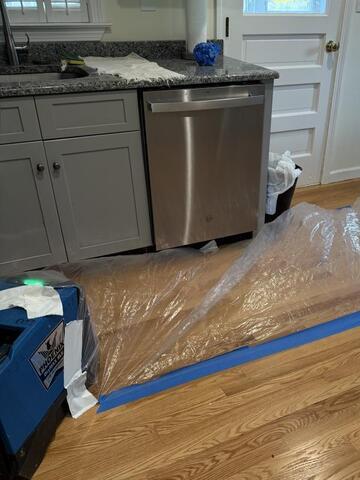
A client’s home that had water damaged hardwood floors in Madison, CT is a perfect example of our restoration-first philosophy. Many restoration contractors would have immediately recommended removing and replacing the flooring. After all, hardwood flooring can be one of the most challenging materials to restore after a water loss.
We don't immediately reach for the pry bar at PCRS.
We reach for our moisture meters.
After a thorough evaluation, including moisture mapping throughout the affected area, our technicians determined that this floor could potentially be saved through controlled drying techniques. Using specialized drying equipment and containment methods taught through the IICRC, we created a drying chamber designed to draw moisture from the flooring system while minimizing additional damage.
The drying process required knowledge, patience, and constant monitoring, but the results were worth it.
The hardwood floor was successfully restored and ultimately required only sanding and refinishing rather than complete replacement.
Think about what that means for both the homeowner and the insurance company.
The homeowner was able to keep the original flooring they chose for their home and avoid the inconvenience and disruption of a major reconstruction project.
The insurance carrier avoided paying for demolition and the many associated costs that come with replacing an entire hardwood floor system.
An important consideration here, potentially misunderstood or overlooked by both restoration contractors and homeowners, is that demolition focused practices can lead to claims being designated as a “large loss”. This is bad news for your insurance carrier but more importantly it could mean bad news down the road for you, the insured.
The severity and source of the loss can have compounding effects at your policy’s renewal time. From the insurance carrier’s perspective:
-
A $50,000 water loss represents a much larger payout by the carrier than a $5,000 loss.
-
As such, Large losses can, and often do, trigger additional underwriting review and could result in:
-
Higher premiums
-
Water damage exclusions
-
Requirements for plumbing upgrades
-
Non-renewal in some markets
Everyone wins when we are able to save what others call unsalvageable.
Remember — The Choice Is Yours
We believe restoration should be attempted before replacement whenever it is safe and practical to do so. After all, it's our responsibility as restoration professionals to save what we can.
That's because restoration isn't measured by how much material you remove.
It's measured by how much you save.
For nearly 40 years, our family-owned and operated company has helped Connecticut homeowners recover from water damage by focusing on mitigation, drying science, and restoration-first thinking.
When knowledge, experience, and proper drying techniques come together, we can restore hardwood floors, cabinetry, and building materials that others may have discarded.
At PCRS, we're delivering exactly what homeowners, insurance professionals, and restoration contractors should expect: restoring rather than replacing.