Why is my home always so dusty?
Why Is My Home So Always Dusty?
When we visit a homeowner to evaluate their property, we hear the same pains over and over again. In some homes, it may be upholstery which a pet has designated as their special place and requires regular upkeep to reduce odors. In other homes, it may be a poorly functioning clothes dryer which has been choked by neglected maintenance. Some homes have unchecked basement humidity levels which cause the familiar odor of mildew to creep upstairs on particularly warm days.
Each home presents its own unique challenges, but one thing we hear constantly is:
“I dust regularly. Why is my home always dusty?”
We get it. We own homes, we clean homes, and we understand that dealing with indoor dust accumulation can feel like fighting a losing battle.
Let’s set the stage.
You spent part—or even most—of your weekend dusting, vacuuming, and cleaning hard surfaces only to find a noticeable layer of dust visible just a few days later. Where does this dust come from?
The answer is usually more complicated than people realize.
To understand why dust keeps returning and how to address it, you first need to understand that dust isn’t just dirt. Dust is actually a mixture of a lot of things: dead skin cells, textile fibers, pet dander, pollen, soil, dust mite waste, and organic materials brought into the home from outdoors.
All of these components of dust continuously generate as part of normal life. While outdoor contaminants certainly contribute to the dust we find indoors, a significant portion of household dust is actually generated inside the home every single day.
As we go through our daily routines, we generate dust. Our bodies shed skin cells, clothing and fabrics release microscopic fibers, pets contribute dander and hair, and everyday activities like cooking, walking across carpet, making beds, or sitting on upholstered furniture contribute to the overall dust load in a home every day.
The result is a never-ending maintenance cycle that can feel daunting for even the most meticulous homeowners.
The good news is that while dust can never be completely eliminated, understanding where it comes from and how it moves through a home can help homeowners gain control of the problem and keep dust levels lower for longer.
Dust Doesn’t Disappear — The Dust Relocation Program
Now that we understand dust is always going to be part of daily life, we can talk about what happens when you clean and how dust travels through your home.
One of the reasons dust can be so frustrating is that cleaning doesn’t necessarily remove all of it from the home. While dusting can certainly improve the cosmetic appearance of your living space, much of the dust that exists within a home remains hidden from view.
Each time the HVAC system cycles on and off, air movement has the potential to disturb dust hidden within your home’s ducting system. Each time the air moves, the dust moves with it.
The same thing happens when we go about our daily routines. Walking across carpet, sitting on a couch, making a bed, or even opening and closing doors can disturb settled dust and send it back into circulation.
This is part of the reason why a home can appear clean one day and dusty again just a few days later.
Dust is constantly forming, constantly settling, and constantly being moved around.
At PCRS, we like to think of the hidden places where dust settles as reservoirs. These reservoirs act as hidden caches of the dust that drives homeowners crazy. Every time air moves through the home or daily activities disturb these areas, a portion of that dust can be reintroduced into the living environment.
Some reservoirs are readily apparent. Carpets, area rugs, upholstered furniture, mattresses, and pet bedding all have the ability to accumulate dust over time. Other reservoirs are less apparent. Ductwork, dryer vents, basements, utility spaces, and other rarely cleaned areas can all contribute to the overall dust load within a home.
Most homeowners focus on the dust they can see while some of the largest reservoirs of dust are hidden in places they rarely think about.
Because of this, the goal becomes less about elimination than it does about reduction. Keep the reservoirs of dust throughout your home as low as possible and there are fewer opportunities for dust to spread around.
Breaking the Cycle
Dusting hard surfaces the old-fashioned way removes some of the dust, but the largest reservoirs are often hidden in places that aren’t part of most homeowners’ regular cleaning routines. Unless those reservoirs are emptied, the cycle simply continues.
The most obvious reservoirs are carpets, area rugs, and upholstered furniture. In many ways, these soft surfaces act as your home’s largest filter. As dust, dander, pollen, textile fibers, and other contaminants are introduced into the living environment, a significant portion eventually settles into these materials.
While dusty carpets and upholstery are never the goal, they do represent reservoirs that can be effectively cleaned and maintained before accumulated dust has an opportunity to continue cycling throughout the home.
Every footstep across a carpet, every time someone sits on a couch, and every time a pet settles into its favorite spot can disturb accumulated dust and send a portion of it back into circulation. Regular carpet and upholstery cleaning helps remove dust from these reservoirs before it has an opportunity to continue cycling through the home.
Of course, dust doesn’t just settle on the surfaces we see every day.
What hides behind walls, above ceilings, and inside mechanical systems may not be at the forefront of your mind, but these areas play a significant role in dust accumulation and overall indoor air quality.
Air ducts can accumulate dust over time and become part of the home’s dust relocation program. Every time the HVAC system cycles on and off, air movement has the potential to disturb and redistribute particles throughout the living space.
Dryer vents deserve attention as well. Most homeowners think of dryer vent cleaning as a fire prevention or efficiency service, but neglected dryer vents can also contribute to excess humidity and airflow issues that affect the overall indoor environment.
The takeaway is simple: mechanical systems matter. While they often operate quietly in the background, they play an important role in how air—and the dust carried within it—moves throughout your home.
But What About What Remains?
Putting systems in place to address the remaining dust in your home can be a reasonable next step once the major reservoirs have been addressed. The goal is to reduce the overall dust load within the home and limit the opportunities for airborne particles to settle back into the reservoirs we’ve worked to reduce.
Even after carpets, upholstery, ducts, and dryer vents have been addressed, dust generation doesn’t stop. People continue to live in the home, pets continue to shed, and daily life continues to generate dust.
This is where air purification becomes an important part of the equation.
Every particle captured by an air purification system is one less particle available to settle into the reservoirs throughout your home.
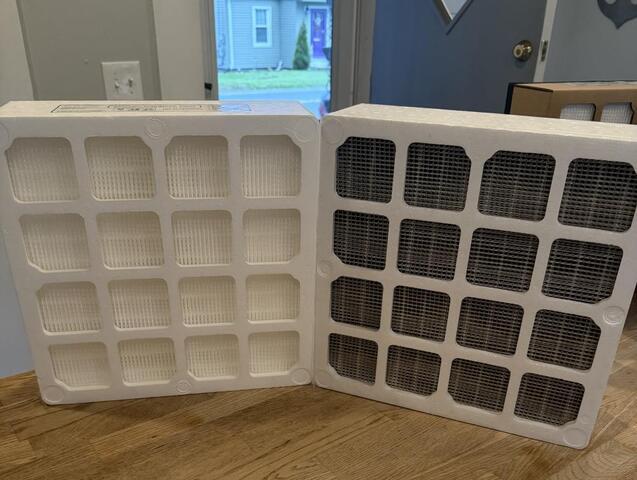
The Aspen Air Purification System continuously captures airborne dust, dander, textile fibers, and other microscopic particulates as air moves through the home. Rather than allowing those particles to complete another lap around the house and refill the reservoirs we’ve worked to reduce, they become trapped within the filtration system where they remain until the filter is replaced.
Many homeowners are surprised when they see what accumulates on an Aspen filter after just a few months of operation. Everything captured by that filter is material that otherwise would have remained suspended in the air or eventually settled somewhere within the home.
In many ways, air purification helps interrupt the dust relocation program.
Instead of settling back into carpets, furniture, bedding, and other dust reservoirs, those particles reach their final destination: the filter.
A Smarter Approach to Dust Management
Dust is simply a fact of life. As long as people live in homes, dust will continue to be generated.
The objective isn't perfection. The objective is reducing the amount of dust stored within the reservoirs throughout your home and limiting the opportunities it has to re-enter the living environment.
By combining regular soft surface cleaning, proper maintenance of mechanical systems, and effective air purification, homeowners can often spend less time chasing dust and more time enjoying a cleanest, healthiest, most comfortable home possible.