The Stack Effect - Your Homes Respiratory System
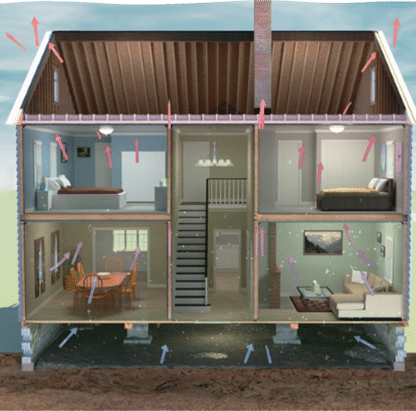
We often think of our homes as a collection of different rooms. The basement holds mechanical systems, the attic is where you store your holiday decorations, and life happens in the rooms between, but your house doesn’t actually work that way.
Every day, air moves throughout the building, carrying heat, moisture, odors, dust, and airborne particles from one area to another, connecting every room whether we realize it or not. Building scientists call this phenomenon the stack effect, and it functions like an invisible river running through your home. You may not be able to see the river, but you can certainly detect its byproducts as dust is redistributed, odors migrate, and moisture travels throughout the building.
Your Home Breathes
While a structure doesn’t breathe in the same manner as living things, the laws of physics dictate that a continually fluctuating volume of air flows through your home every day. Air is always trying to reach equilibrium. Whenever there is a difference in temperature or pressure, air naturally moves to equalize those differences.
The stack effect gets its name from a literal chimney stack. Imagine a tall chimney above a fireplace. As the fire heats the air inside the chimney, that warm air rises and exits through the top. As the air escapes, it leaves behind a slight vacuum in the form of negative pressure at the bottom. This draws fresh air into the fireplace to replace it.
Your home functions in a very similar fashion. Your furnace, sunlight, appliances, and even the home’s occupants warm the air inside, which naturally rises through the upper floors toward the attic.
The important takeaway here is not just the air or the temperature—it’s what the air picks up on its journey. Air is an incredibly effective transportation mechanism. As it travels through a home, it doesn’t simply pass from one room to another. It interacts with every space it passes through, carrying microscopic particles that are often invisible to the naked eye and affecting your indoor air quality.
If the air passes through a damp basement, for example, it may pick up mold spores and excess moisture. Air moving through dry, dusty crawlspaces may carry fine dust, insulation fibers, and other particulate matter. As air moves across soft surfaces like carpets and upholstery, pet dander, pollen, and the allergens associated with dust mites can be disturbed and become airborne. Most of these contaminants are too small to be detected by the naked eye, but they remain in the home and continue to travel and relocate as your home breathes.
Following the Air
Now that we have established that the air in your home is continuously moving, the connection to indoor air quality begins to take shape. The air you breathe in your bedroom has, in all likelihood, made quite a journey and brought many hangers-on with it. Inflammatory mold spores, textile fibers, pet dander, pollen, and fine particulate matter can all hitch a ride as warm air rises and escapes through the upper levels of the home.
As that air leaves, it creates a slight negative pressure in the lower portions of the house. Nature doesn’t like pressure imbalances, so replacement air is drawn through rim joists, foundation penetrations, crawlspaces, basements, and other small openings wherever it can find a path inside. This continuous cycle of air entering low and exiting high is the driving force behind the stack effect.
While you may think of your basement as the lowest level of a building, we think about it as ground zero for the air you breathe. Let that sink for a moment. Your basement is often the starting place of every breath taken inside your home.
Taking a Look at the Whole Picture
Understanding the stack effect makes it easier to see that indoor air quality is rarely an issue isolated to a single room or area of the home. The dust accumulating in a bedroom may have begun its journey in the basement, while a musty odor upstairs may be the result of excess moisture below.
The dark staining often seen above baseboard heaters is an excellent example of this principle. These marks are often the result of airborne particles collecting as warm air rises along the wall. This phenomenon is known as ghosting, or thermal tracking.
What you're seeing is visible evidence that your home is constantly "breathing." As warm air rises, it carries microscopic particles with it, depositing them where changing temperatures and airflow patterns allow them to settle. It's one of the few times the invisible movement of air leaves behind something we can actually see.
Once you begin recognizing these clues, you start looking at your home differently. Instead of seeing isolated problems, you begin to see a connected system. That's the foundation of our Whole Home Approach. Rather than focusing on a single symptom or room, we look at how air, moisture, and contaminants move throughout the entire home to identify the source of the problem—not just where it happens to appear.
Seeing Your Home Differently
The stack effect is occurring whether you notice it or not. Each day your home is drawing in outside air and moving the air inside it along with all the particles the air comes in contact with. Moisture, odors, dust, mold, and allergens all become stowaways as the air moves.
As your indoor air quality professionals, we encourage homeowners to think beyond the symptoms they’re experiencing. Instead of asking “Why does my home smell musty?” or “Where did all this dust come from?” or “Why are my seasonal allergies not leaving with the season?”, we ask that you consider what conditions may exist that allowed them to develop in the first place.
This is the foundation of our Whole Home Approach. Rather than focusing on a single room or isolated issue, we investigate and focus on how your home behaves to determine the source. Your house is an interconnected system governed by the laws of physics, where air is continuously moving and carrying whatever it encounters along the way.
Every evaluation we perform begins by looking at the home as a whole system. By understanding how air moves through a building, we can identify the conditions contributing to indoor air quality concerns and recommend solutions that address the source, not the symptom.
After all, if your entire home is connected by the air you breathe, it only makes sense to treat it that way.