Control, Treat, and Remove: How the HEPA Sandwich Fits Into Mold Remediation
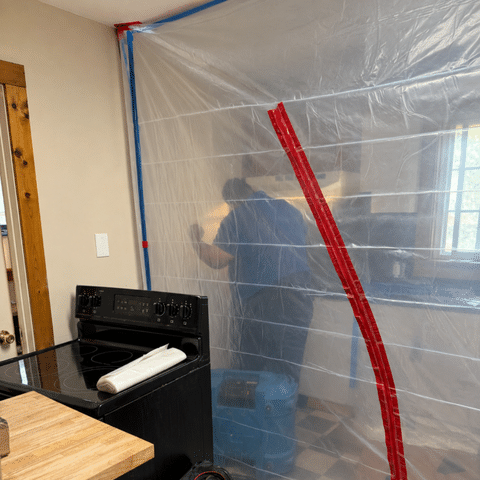
At every mold remediation project we work on, our IICRC-trained technicians install proper containment using plastic sheeting, ZipWall barriers, and other materials designed to isolate the work area from the rest of the home. We do this to prevent dust, debris, and airborne mold spores disturbed during remediation from spreading into unaffected areas.
Because containment can temporarily make certain areas of a home more difficult to access, homeowners sometimes ask us why the barriers are necessary. The answer is pretty straightforward; mold remediation is as much about controlling and removing contamination as it is about preventing that contamination from being spread somewhere else.
If you had an interior painting contractor in your home, you would expect that their work area is protected to prevent getting paint onto surrounding surfaces. Mold remediation follows a similar principle, but the reason for containment is more specialized. When mold-affected materials are disturbed, spores and contaminated dust can become airborne and travel beyond the immediate work area. Unlike a paint splatter, that spread may not be visible to the naked eye.
This is why containment is so important. It helps isolate the work area and reduce the chance of cross-contamination into unaffected parts of the home while remediation is under way.
While containment creates a physical barrier between the remediation area and the rest of the home, we also need to control the air moving within that space. During many mold remediation projects, we operate a HEPA-filtered air scrubber inside the contained work area. These machines continuously pull air through HEPA filtration to capture airborne particles that may be released while affected materials are being removed or cleaned. When the system is configured to establish negative pressure, filtered air is exhausted from the contained area, helping create a pressure difference between the work area and the surrounding home.
But what does negative pressure mean?
Negative pressure simply means that the air pressure inside the contained work area is slightly lower than the air pressure outside of it. Because air naturally moves from areas of higher pressure to lower pressure, this helps encourage air to flow into the containment rather than allowing potentially contaminated air to move out into the unaffected areas of the home.
The result is controlled airflow into the contained work area rather than outward into the surrounding home. In a properly established containment environment, this helps keep airborne particles from escaping the work area while remediation is taking place.
If you have observed containment in your home during a remediation project, you may notice that the plastic walls are pulling slightly inward. That is negative pressure at work, helping us keep the contamination we are addressing contained within the work area.
Once we have the work area sufficiently contained and the air inside is being controlled by our air scrubber, the next step is to address the affected materials themselves.
Depending on the extent of the mold growth and the materials involved, some building materials may need to be removed entirely. Porous materials like drywall and insulation can be difficult or impossible to effectively clean once mold growth has affected them. In these situations our technicians carefully remove the materials while containment and negative pressure are in place to control the dust and debris that removal can generate.
Once the unsalvageable materials are removed what remains must be meticulously cleaned using a process commonly referred to as the HEPA sandwich. The HEPA sandwich method gets its name from combining three separate cleaning methods that work together to remove contamination.
The first step, or the top of the HEPA sandwich, is HEPA vacuuming. During this step, our technicians methodically vacuum the remaining surfaces to remove loose dust, debris, mold spores, and other particulate matter. Just as important as removing those particles is what happens afterward: the HEPA vacuum is designed to capture and contain fine particulate rather than simply redistribute it back into the work area.
Step number two, or the middle part of the sandwich is wet wiping and cleaning. After the loose particulate has been removed with the initial HEPA vacuuming, our technicians wet wipe the remaining structural surfaces to physically remove contamination that may still be adhered to the materials. On rough or irregular surfaces where wiping alone is not sufficient, we may also use a brush to agitate and then clean the surface more thoroughly.
An antimicrobial solution may also be applied to the cleaned surfaces during this step as part of the remediation process. It is important to remember, however, that controlling the underlying moisture condition is what ultimately helps prevent mold from returning.
When staining remains on materials such as attic roof decking or wall studs after cleaning, we may also use a stain-removal agent to address the residual discoloration. This stain-removal step improves the appearance of the material, but it is separate from the physical removal of contamination that occurs during HEPA vacuuming, wet wiping, and scrubbing.
The final step, or the bottom of the HEPA sandwich, is a second round of HEPA vacuuming. Once the wet wiping, scrubbing, and any other necessary cleaning steps are complete and the surfaces have dried, our technicians methodically HEPA vacuum the area again.
This final pass is important because the wet-cleaning process can loosen additional dust, spores, and particulates from the surfaces being treated. The second HEPA vacuuming helps capture and contain any remaining material, leaving the structural surfaces as thoroughly cleaned as possible before the containment is removed.
That is what makes the HEPA sandwich effective: it is not a single cleaning step or the application of one product. It is a deliberate sequence of HEPA vacuuming, physical wet cleaning, and final HEPA vacuuming designed to remove contamination from the affected materials while containment and air filtration continue to protect the surrounding areas of the home.
Mold remediation is not simply about removing what you can see. A properly managed project involves controlling the work area, managing airborne particulates, removing materials that cannot be salvaged, and thoroughly cleaning the structural surfaces that remain.
While our HEPA-filtered air scrubbers operate within the containment, we also typically run an Aspen air purifier in the living space outside of the work area. This gives us an additional layer of HEPA filtration in the portions of the home that remain occupied while remediation is taking place and helps continuously filter airborne particulates from the surrounding indoor air.
From the containment and negative pressure to the HEPA sandwich and air filtration, each part of the process serves a specific purpose. The goal is not simply to make an affected area look clean again. It is to perform the remediation in a controlled, methodical way while protecting the unaffected areas of the home and leaving the treated space as thoroughly cleaned as possible.
Once the remediation is complete it’s important to understand that even the most thorough mold remediation cannot prevent future growth if the moisture conditions that allowed mold to grow in the first place are not corrected.
Mold requires moisture to grow, and identifying the source of that moisture is imperative to keep it from returning. Depending on the home, that may mean repairing a roof, improving attic or basement ventilation, repairing a leaking appliance or plumbing, or controlling elevated humidity with dehumidification.
This is also where mold remediation connects directly to our Whole Home Approach. We do not look at an isolated area of mold as a problem that exists completely on its own. We look at how moisture is moving through the home, how the affected area may be interacting with the surrounding living space, and what can be done to help create a cleaner, healthier, and more comfortable indoor environment overall.
That philosophy guides the way we approach every project. Containment protects unaffected areas, air filtration helps manage airborne particulates, the HEPA sandwich addresses contaminated surfaces, and moisture control helps reduce the conditions that allow mold to return.
For us, successful mold remediation is not just about removing what is visible today. It is about understanding the home as a complete system and taking the steps necessary to leave our clients with the cleanest, healthiest, most comfortable home possible.