Mold Remediation and Whole Home Wellness: Investigation, Discovery, & Treatment
One of the largest challenges in determining how to improve the overall indoor air quality of a home is that the answer is not always immediately apparent. A homeowner often does not know why they are noticing bad odors or simply feel that the air in their home is not as clean as it should be.
Frequently, some of the first places we investigate are basements and other areas where elevated humidity and moisture are common. However, when we perform a Whole Home Indoor Air Quality Assessment, our investigation does not stop there. A home functions as one interconnected environment, which means the source of an indoor air quality concern may be somewhere the homeowner rarely sees.
At one home we recently investigated, the basement was not the culprit after all. When we entered the attic, it quickly became clear that there was a ventilation problem. The soffit vents intended to promote airflow through the attic were too small and had also been blocked by insulation, preventing the amount of airflow needed to properly manage humidity within the space.
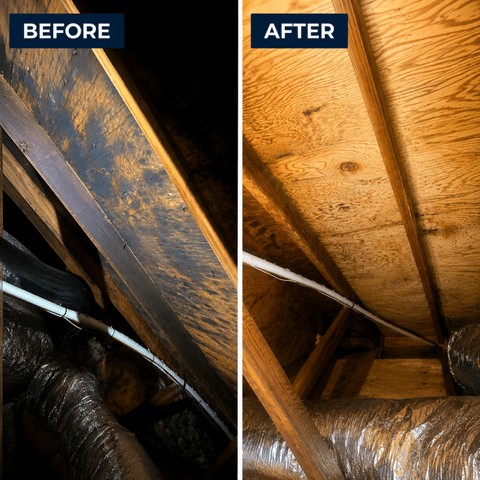
It was also apparent that these conditions had been present for quite some time. Extensive dark microbial staining was visible across portions of the wood roof decking, and we found additional affected areas beneath the blown-in insulation. Before we could properly remediate the attic, that insulation needed to be removed so our technicians could access all of the affected surfaces.
Because disturbing microbial growth during remediation can release particulates into the air, we constructed containment around the attic access to separate the work area from the occupied areas of the home. This allowed our technicians to work within a controlled space while reducing the potential for material disturbed during remediation to migrate into other areas of the house.
The project took four days to complete, and during that time we also ran an Aspen Air Purifier outside of the containment to provide additional filtration for the air within the living space. The purifier was not being used as a substitute for containment or remediation. It was another layer of filtration for the occupied areas of the home while the work was taking place in the attic above.
Once the blown-in insulation had been removed and we could access the affected roof decking, we used the HEPA sandwich method to remediate the surfaces.
The process begins with HEPA vacuuming to remove loose particulate from the affected material. The surfaces are then cleaned and treated with an antimicrobial application, with additional agitation where necessary. Once that portion of the cleaning process is complete, the surfaces are HEPA vacuumed again to capture particulates that may have been loosened during the remediation.
The goal is not simply to make dark staining on the wood look better. Mold remediation is about physically removing microbial growth from the affected building materials while controlling what is disturbed during the process.
This particular home is a good example of why we look at indoor air quality from a whole-home perspective. The homeowner was not spending time in the attic and had no reason to regularly inspect the space, but the conditions developing there were still part of the overall environment of the home. Had we limited our investigation to the basement or the main living areas, we may never have identified the source of the concern.
This is also why improving indoor air quality requires more than simply testing the air or adding filtration. If there is a source within the home continually contributing moisture, particulate, microbial growth or other contaminants, identifying that source is an important part of developing an effective treatment plan.
Our philosophy toward indoor air quality starts with understanding that every home is different. We don't walk into a home assuming that an air purifier, duct cleaning, dehumidifier or any other individual service is automatically going to solve the problem. Before we can develop a treatment plan, we first want to understand what conditions within the home may be contributing to the concern.
Our goal during a Whole Home Indoor Air Quality Assessment is to identify those potential sources and conditions first and then develop a treatment plan based on what we actually find. Sometimes that may include remediation. In another home it may mean controlling humidity, improving filtration, cleaning accumulated reservoirs of dust and particulate, addressing ventilation or a combination of several approaches.
In this home, better filtration alone would not have addressed years of elevated humidity and microbial growth in the attic. We first had to identify the source, remediate what had developed and address the conditions that allowed it to happen in the first place.
One of the more important takeaways from this project is how quietly conditions like these can develop. There was not one dramatic water loss that suddenly created a problem in the attic. Instead, inadequate ventilation allowed elevated humidity to persist over a long period of time. Because the attic was rarely used, there was little reason for the homeowner to recognize what was happening until the conditions had already become significant.
Attics, basements and other unfinished areas of a home are easy to overlook, but the conditions within those spaces can change over time. Ventilation can become obstructed, insulation can restrict airflow, humidity levels can become elevated and small moisture problems can remain unnoticed for years. Identifying those conditions earlier can make a significant difference in what eventually needs to be done.
For us, this project was a good reminder that some of the most important parts of a healthy home are the parts we don't see every day. A healthier indoor environment starts with understanding the entire home, not just the rooms we live in every day.